
Retaining Wall Installation by Licensed Hardscape Contractors
Rock N Block Turf N Hardscapes designs and builds custom retaining walls for homes in Las Vegas, Phoenix, San Diego, Orange County, Santa Clara County, Denver, Tampa, and St. George. We build segmental block, natural stone, and tiered retaining walls. Every wall gets a compacted base, drainage aggregate, and a perforated drain pipe, so it holds soil and sheds water for decades. Our crews are licensed in Nevada, California, Arizona, and Utah,
Retaining Walls for Sloped Yards, Erosion, and Drainage Problems
A retaining wall holds back soil so a slope can become level, usable ground. Homeowners usually call us for one of four reasons:
- A sloped backyard. They want flat space for a patio, turf, or play area.
- Erosion. Soil is washing onto walkways or toward the foundation.
- Water runoff. It pools against the house or fence.
- An old wall is failing. It’s leaning, bulging, or cracked.
Types of Retaining Walls We Build
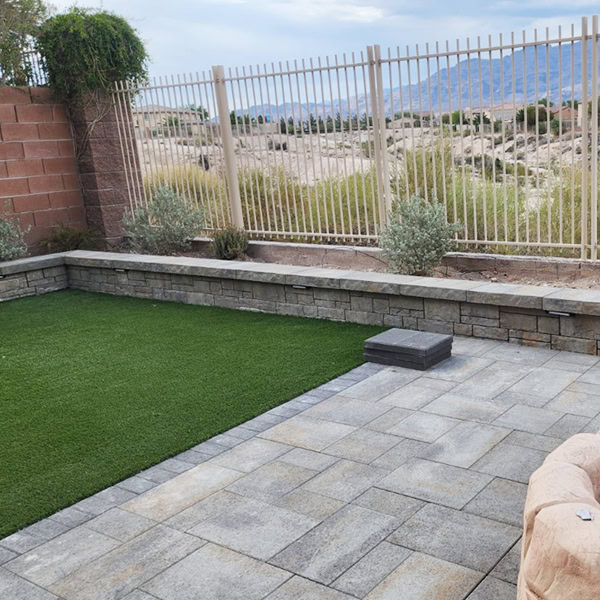
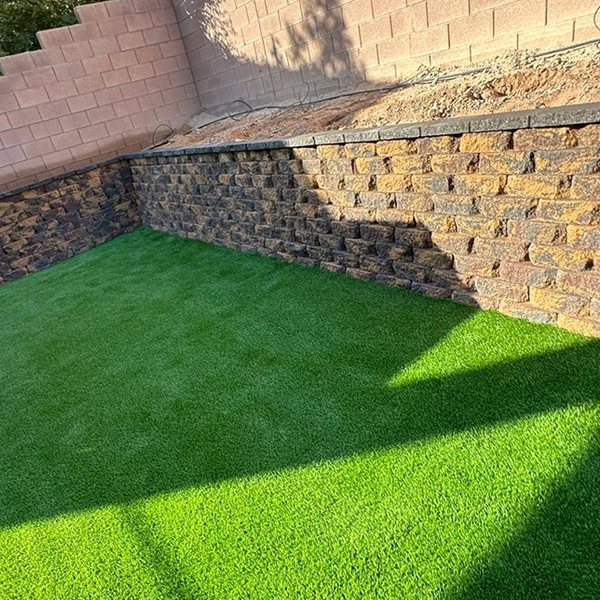
- Segmental (Interlocking Concrete Block) Retaining Walls. Modular blocks stack without mortar and lock together with lips or pins. They are the most common choice for residential walls because they are strong and flexible, and taller walls can be reinforced with geogrid.
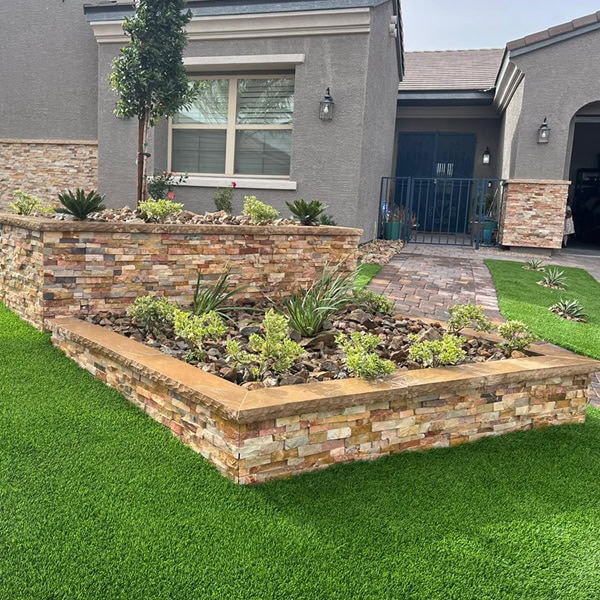
- Natural Stone Retaining Walls. Natural stone suits garden walls, desert landscapes, and upscale properties where the wall is a design feature.
- Tiered Retaining Walls. Two or more shorter walls step up a steep slope. This often avoids the engineering requirements that apply to one tall wall, and it creates planting terraces.
- Seat Walls and Planter Walls. Low walls around patios and fire pits add seating and raised beds. They pair with our paver installation and outdoor living projects.
Our Retaining Wall Installation Process
- Site evaluation. We measure the slope height and soil type, and identify where water drains.
- Design and permitting. We choose the material, height, and drainage plan, and handle permits and engineering when required.
- Excavation and base. We dig a trench below grade and compact a gravel base so the wall can’t settle.
- Build and reinforce. We level the first course, stack the block or stone, and add geogrid on taller walls.
- Drainage. We backfill with clean drainage aggregate around a perforated drain pipe that carries water away.
- Cap and finish. We set cap stones, regrade, and tie into surrounding landscaping or turf.
Why Retaining Walls Fail (and How We Prevent It)
Most retaining walls fail from water pressure, not weight. When water saturates the soil behind a wall, it pushes outward until the wall leans, bulges, or collapses. The other common causes are a shallow or uncompacted base, missing geogrid on taller walls, and native soil used as backfill. Every Rock N Block wall includes drainage aggregate, a perforated drain pipe, and a compacted base sized to the wall height.
What Affects Retaining Wall Cost?
Retaining wall cost depends mainly on six things:
- Height and length. Pricing is usually by face square foot.
- Material. Block, natural stone, and poured concrete are priced differently.
- Site access. Whether equipment can reach the work area.
- Soil conditions and excavation.
- Reinforcement and drainage. Taller walls need geogrid and more drainage work.
- Permits and engineering. Required on taller walls.
We give a written quote after a free on-site consultation.
Do You Need a Permit or an Engineer for a Retaining Wall?
In many U.S. jurisdictions, a retaining wall over 4 feet tall needs a building permit, and often a stamped engineering design. The height is measured from the bottom of the footing to the top of the wall. Walls of any height that hold up a driveway, structure, or slope above (called a “surcharge”) often need one too. Rules vary by city and HOA, so we confirm the requirements for your address during the consultation.
Service Areas
| Las Vegas, NV | Santa Clara County, CA |
| Phoenix, AZ | Denver, CO |
| Orange County, CA | Tampa, FL |
| San Diego, CA | St. George, UT |
Rock n Block proudly serves the major cities listed above, in addition to surrounding areas.
Retaining Walls Frequently Asked Questions
What is the best material for a retaining wall?
For most homes, segmental concrete block gives the best mix of strength, cost, and lifespan. Natural stone is best when appearance is the priority. Timber is the cheapest option but typically lasts the shortest.
How long does a retaining wall last?
A properly drained concrete block or stone wall typically lasts 50+ years. Timber walls often last 10–20 years. Drainage is the biggest factor in lifespan.
Do I need a permit to build a retaining wall?
Often yes for walls over 4 feet, or for walls supporting a surcharge. We check your local requirements and handle permitting.
How do you handle drainage behind a retaining wall?
We backfill with clean gravel, install a perforated drain pipe at the base, and grade the top so water moves away from the wall.
How long does retaining wall installation take?
Most residential walls can take weeks depending on size, access, and permitting.
Can you build a retaining wall on a steep slope?
Yes. Steep slopes are often terraced with tiered walls, or built with geogrid-reinforced block engineered for the height.
Can a retaining wall be combined with turf or pavers?
Yes. Many clients level a slope with a retaining wall and then finish the new flat area with artificial turf or pavers.