
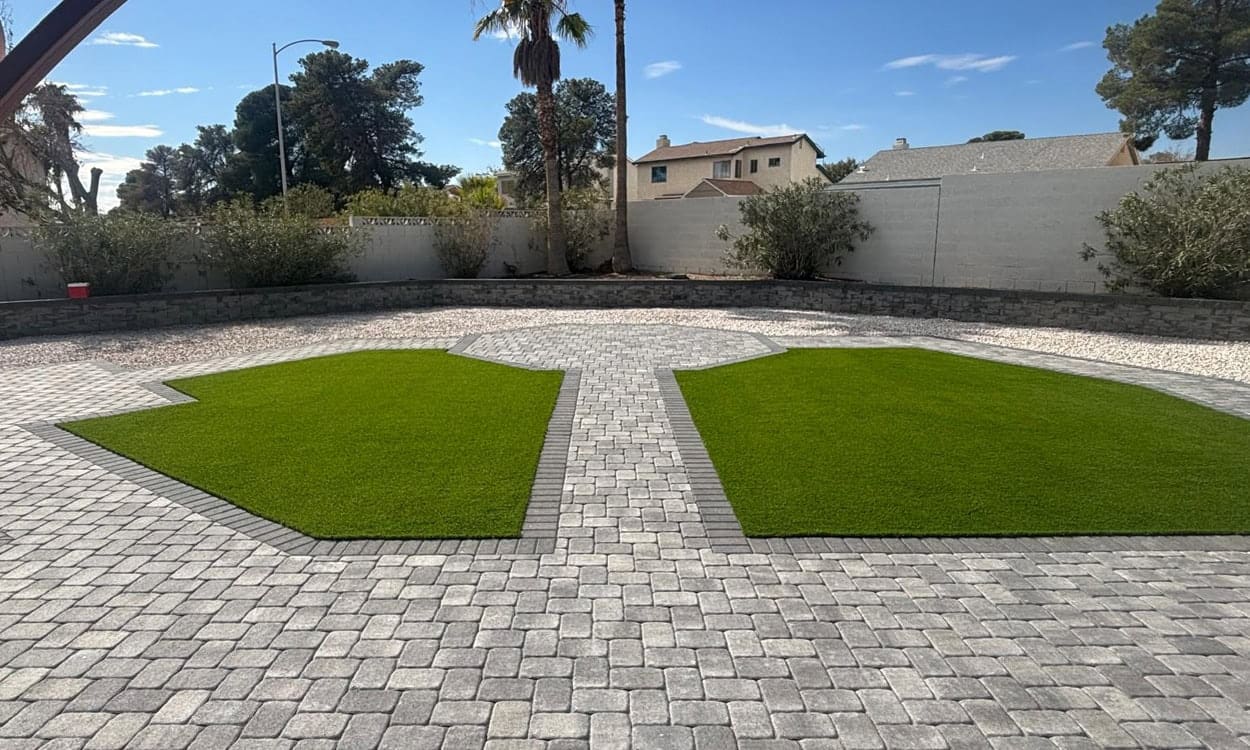
A patio is one of the few outdoor projects you’ll live with for decades, so the surface you pick matters more than the furniture you put on it. Rock N Block Turf N Hardscapes has spent 20 years building outdoor spaces for homeowners, and our crews install both paver patios and poured concrete. That gives us a straightforward view of where each one performs well and where it falls short.
Pavers vs. concrete, in short: A concrete slab is a single poured surface that costs less upfront but can crack and is hard to repair invisibly. A paver patio is built from individual interlocking units over a compacted base. It costs more to install, lasts longer, and lets you replace a damaged section without tearing out the whole patio.
Below, we walk through how each option is built, how long the work takes, what it costs, and how the warranties compare.
What’s the Difference Between a Paver Patio and a Concrete Slab?
The difference comes down to one continuous surface versus many interlocking pieces.
A paver patio is made of individual units, typically interlocking concrete, natural stone, or brick, laid in a pattern over a compacted base and bedding sand. Joint sand locks the pieces together. Common paver materials include:
- Concrete pavers: Durable, cost-effective, and available in many colors and shapes.
- Brick: A classic look with a traditional feel.
- Flagstone: Irregular natural stone for a more organic layout.
- Granite: Dense and formal.
- Travertine: A textured natural stone popular for patios and pool areas.
A concrete slab is poured on site into wooden forms, reinforced with steel rebar or wire mesh, finished, and left to cure. You can add stamping, staining, or decorative aggregate to change the surface look, but the slab remains one solid piece.
That structural difference drives almost everything else in this comparison: cost, repairs, drainage, and how each surface handles ground movement.
How Is Each Type of Patio Built?
Both surfaces start with the same rule: what’s underneath decides how long the patio lasts.
How We Install a Paver Patio
Our paver installation process follows these steps:
- Mark the layout: We stake and string the patio boundaries and confirm the dimensions.
- Excavate: We dig to the required depth and clear out rocks and debris.
- Level and compact the soil: A plate compactor firms up the ground so the pavers don’t shift or settle later.
- Lay the bedding sand: We spread it to a uniform thickness, level it, and lightly wet it so it settles into any voids.
- Set the pavers: Our crew places each paver in your chosen pattern, such as herringbone or running bond.
- Lock the joints: We sweep polymeric sand into the joints, run a compactor over the surface to settle it, then mist it with water so the sand hardens. The hardened joints hold the pavers in place and keep weeds from coming up between them.
How a Concrete Slab Is Poured
For poured concrete, the process looks like this:
- Consultation and planning: Choosing the concrete type, finish, and layout.
- Site preparation: Clearing, grading, and compacting the soil.
- Formwork: Building forms that define the slab’s shape and hold the wet concrete.
- Reinforcement: Placing rebar or wire mesh inside the forms.
- Pouring and finishing: Placing the concrete and applying any stamped, stained, or aggregate finish.
- Curing and sealing: Letting the slab cure fully, then applying a protective sealant.
The step that separates the two methods is curing. Pavers are a finished surface once the joints are locked. Concrete needs time to develop its strength before it can carry weight.
How Long Does Each Project Take, Start to Finish?
For a typical backyard patio, the hands-on work for both options is measured in days. The difference is what happens after the crew leaves.
| Stage | Paver Patio | Concrete Slab |
| Consultation and design | Varies by project | Varies by project |
| Site prep and base | Contingent on project size | Contingent on project size |
| Installation or pour | Contingent on project size | Contingent on project size |
| Before the surface is usable | Once the polymeric sand has hardened | At least a few days to set |
| Before heavy loads | Once the polymeric sand has hardened | At least a week of curing |
Concrete pours can go faster on smaller slabs, but you’ll be keeping people, furniture, and vehicles off the surface while it cures. Pavers take longer to lay because every unit is set by hand, especially in detailed patterns like herringbone.
Pavers vs. Concrete: Cost, Lifespan, and Upkeep
Concrete wins on upfront price. Pavers tend to win on everything that happens after installation.
| Factor | Paver Patio | Concrete Slab |
| Expected lifespan | Up to about 50 years | About 25 years |
| Cracking | Joints flex with ground movement | Prone to cracking, sometimes soon after curing |
| Repairs | Replace individual pavers | Patch (visible) or replace the slab |
| Drainage | Water can seep through the joints | Water runs off the surface |
| Color | Dye runs through each paver | Stain or color sits mostly at the surface |
| Traction when wet | Better traction | Can get slippery |
| Rock N Block warranty | 25-year material + 3-year labor | 5-year warranty |
Cost ranges come from published national cost guides. Your price depends on material, pattern, site access, and base prep, so an on-site estimate is the only reliable number.
The lifespan gap is where pavers recover their higher upfront cost. Manufactured concrete pavers are made denser and stronger than a slab poured on site, and when one cracks or stains, you lift it out and set a new one. A cracked slab can be patched, but the patch rarely matches, and widespread cracking usually means demolition.
When a Concrete Slab Makes Sense, and When Pavers Are the Better Call
Neither surface is the right answer for every yard. Here is how we’d frame the decision.
Concrete Slab Benefits
- Lowest upfront cost: A plain slab is one of the least expensive patio surfaces you can install.
- Smooth, continuous surface: There are no joints, which some homeowners with pets prefer, since uneven surfaces can be harder on paws.
- Decorative options: Stamping, staining, and exposed aggregate can give concrete a custom look.
- Simple to maintain: A plain slab is relatively easy to install and keep up.
Paver Patio Benefits
- Longer service life: Pavers can last roughly twice as long as a poured slab.
- Simple, invisible repairs: Damaged pavers are swapped individually, and the repair blends in.
- Better handling of ground movement: The joints let the surface flex slightly instead of cracking under stress.
- Design range: Concrete, brick, flagstone, granite, and travertine, combined with patterns like herringbone or running bond, give you far more control over the finished look.
- Longer warranty coverage: At Rock N Block, pavers carry a 25-year material warranty and a 3-year labor warranty. Concrete carries 5 years.
Choose concrete if your budget is tight, the patio is small and simple, or you want a joint-free surface. Choose pavers if you plan to stay in the home for years, want a specific look, or would rather replace a few pieces down the road than an entire slab.
Why Homeowners Choose Rock N Block for Paver Patios
When pavers are the right fit for your yard, here is what comes with a Rock N Block installation.
Warranty Coverage in Writing
Rock N Block’s lifetime warranty on pavers is defined as a 25-year limited material warranty plus a 3-year labor warranty from the date of installation. If a covered portion of your paver installation fails during that period, we replace the affected area, including labor during the labor-coverage window. Concrete work carries a 5-year warranty covering cracking or chipping, spalling or scaling, and uneven settling caused by installation or material issues. Warranties apply to the original purchaser and are non-transferable. You can read the full terms on our warranty page.
Licensed and Insured
Rock N Block Turf N Hardscapes is a licensed and insured installer with active contractor licenses in:
- Nevada: NV LIC #0089346, NV LIC #0091447
- California: CA LIC #860397
- Arizona: AZ LIC #359837
- Utah: UT LIC #13609960
What Our Customers Say
Rock N Block holds a 4.8-star average across 628 reviews. The themes that come up most are crews arriving on time, finishing early, and leaving the site clean, along with pricing that compared well against other quotes. One recent customer collected nine quotes for both a concrete patio and pavers, expecting concrete to be the cheaper route, and chose Rock N Block for a paver installation. Another compared our work to a patio a different contractor had built for them shortly before and decided to have that earlier patio removed. Read more on our testimonials page or browse finished projects in our paver gallery.
One Team for the Whole Yard
Rock N Block started in Las Vegas and now serves:
- Las Vegas, NV
- Mesquite, NV
- Phoenix, AZ
- Orange County, CA
- Inland Empire, CA
- San Diego, CA
- Santa Clara County, CA
- Denver, CO
- Tampa, FL
- St. George, UT
Along with paver patios and concrete driveways, our crews handle patio covers, retaining walls, artificial turf, and complete outdoor living builds, so you don’t have to coordinate separate contractors. For a look at how patio planning works in a specific climate, see our guide to patio installation in Tampa, or our overview of hardscaping services in Las Vegas.
Build a Patio That Lasts With Rock N Block
A concrete slab keeps the upfront bill lower. A paver patio costs more on day one but gives you a longer lifespan, repairs that don’t show, and a 25-year material warranty from Rock N Block Turf N Hardscapes. For most homeowners planning to stay put, that trade favors pavers.
Ready to compare options for your yard? Contact Rock N Block for a free consultation and an on-site estimate for a paver patio or concrete slab.
Frequently Asked Questions
1. Does my Rock N Block warranty transfer if I sell my home?
No. Rock N Block warranties are non-transferable and cover only the original purchaser, so the 25-year paver material warranty does not pass to a new owner.
2. Does the concrete warranty cover cracks?
Yes, within limits. The 5-year concrete warranty covers cracking or chipping caused by improper installation or material defects, plus spalling, scaling, and uneven settling from subbase or mixing errors. Normal wear and damage from tree roots or nearby third-party work are excluded.
3. Are concrete pavers or brick pavers better for a driveway?
Concrete pavers are well suited to driveways and other high-traffic areas. They handle heavy use, come in a wide range of designs, and can be the more cost-effective option. Either type needs a proper sand bed, edging, and sealing to last.
4. Do pavers drain better than a concrete slab?
Yes. Water can move down through the joints between pavers, while a slab sheds all of its water across the surface.
5. Can I finance a paver patio?
Rock N Block accepts cash, check, credit card, and ACH, and offers financing subject to credit approval, including a 24-month, 0% APR plan if paid in full. See the financing page for terms.