
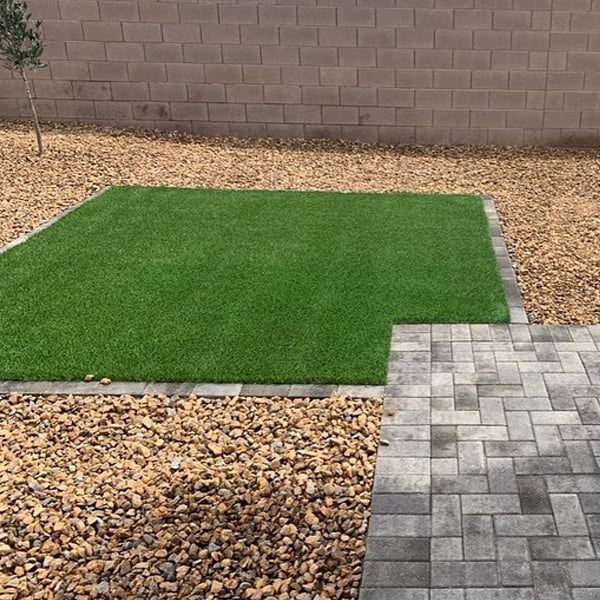
St. George sits in one of the driest corners of Utah, and the cost of keeping a natural lawn alive here shows up on every summer water bill. That is why synthetic grass has moved from a novelty to a standard landscaping choice across Washington County.
The question most homeowners actually want answered is what the project will cost on their property, not what turf costs in general.
What Artificial Turf Costs in St. George Right Now
Professionally installed artificial turf in the St. George area generally runs $8 to $15 per square foot, which puts a 1,000 square foot lawn between roughly $8,000 and $15,000. Where a project lands in that range depends on turf grade, how much old lawn has to come out, base depth, drainage work, and yard access.
Two yards of identical size can price thousands of dollars apart. One might have a flat lawn that strips out in an afternoon. The next might need excavation, regrading, a deeper base, and a drainage fix before a single roll of turf gets unwrapped.
| Turf area | Estimated Planning Range | What usually drives the number |
| 500 sq. ft. | $4,000 to $7,500 | Turf grade, site access, sprinkler capping |
| 1,000 sq. ft. | $8,000 to $15,000 | Sod removal, base depth, labor |
| 1,500 sq. ft. | $12,000 to $22,500 | Grading, drainage, seam count, haul-off volume |
| 2,500+ sq. ft. | Lower per sq. ft., higher total | Volume pricing offsets some material cost |
Larger projects often carry a lower per-square-foot price because mobilization, equipment, and crew time spread across more area. That is one reason a small 300 square foot side yard can feel expensive per foot compared to a full backyard conversion.
The Washington County Rebate Changes Your Net Cost
This is the part most cost guides skip, and it can be worth thousands of dollars in St. George specifically.
The Washington County Water Conservancy District’s Water Efficient Landscape Program pays property owners for qualifying conversions of living, maintained grass to water-efficient landscaping. The standard incentive is currently $2 per qualifying square foot. Projects completed between June 9, 2026, and June 1, 2027, may receive an additional $1 per square foot on the first 1,000 square feet.
That brings the potential incentive during the temporary bonus period to $3 per qualifying square foot on the first 1,000 square feet, with the standard $2 rate applying beyond that.
On a 1,000 square foot conversion, that is potentially $3,000 back against the project cost.
The conditions matter, and this is where homeowners get tripped up:
- Pre-approval comes first: Projects have to be approved before the conversion happens, so tearing out the lawn and applying afterward does not work.
- The turf has to be permeable: Surface treatments must pass air and water, and impermeable surfaces such as concrete do not qualify.
- Living plants are part of the deal: Synthetic turf projects still have to meet the program’s plant coverage requirements, and existing plants and trees outside the conversion area can count toward that.
- Irrigation has to be converted: Spray sprinklers have to become drip, and no spray heads are allowed in the finished area.
- A conservation easement is attached: Payment is tied to an easement that restricts certain uses of the converted area going forward.
The existing lawn must qualify. Projects generally require at least 300 square feet of living, maintained grass. Limited exceptions may apply when all grass is removed from a contiguous area since there is no size minimum.
Any installer quoting a St. George project should be able to tell you whether your yard is a realistic rebate candidate and how the plant coverage and drip requirements affect the design. Confirm current rates and rules directly with the district before you budget around them, because the elevated rate is temporary.
What Actually Drives the Price of a Turf Project
Turf grade and construction
Pile height, face weight, density, blade shape, and backing all move the material price. A front lawn chosen for looks and a dog run chosen for drainage and abrasion resistance are different products at different price points.
Rock N Block Turf N Hardscapes stocks several turf lines, including Rockn-80, Natural-100, Modern-103, and the Rockn Putt-85 putting surface, so the product can be matched to the use rather than the other way around.
Removal and haul-off
Turf goes over a built base, not over living grass. Existing sod, weeds, roots, decorative rock, and a few inches of soil have to come out, and that material has to go somewhere. Disposal volume is a real line item, and it scales with how deep the excavation needs to go.
Base depth and compaction
The base is where installers either earn their price or cut it. Excavation, aggregate, grading, leveling, and compaction happen before the turf appears, and a thin or poorly compacted base shows up later as low spots, movement, and visible seams. The way a crew handles site preparation and base work during installation is a fair thing to ask about line by line.
Drainage
Artificial turf does not need routine irrigation, but permeable turf still has to move rainwater through the surface and base. Properties that already pond or drain toward a foundation may need grading or dedicated drainage work as part of the installation. Yards that already pond or drain toward a foundation need that solved during the build. Fixing it later means pulling turf back up.
Layout and access
Curves, tree wells, planters, slopes, and narrow gates all add cutting, seaming, and hand labor. A rectangular lawn with a wide side gate is the cheapest possible version of the same square footage.
Combined hardscape work
Many St. George projects pair turf with paver patios and walkways or a retaining wall to hold a grade. Bundling that work into one mobilization is usually cheaper than sequencing three separate contractors.
What a Real Turf Quote Should Itemize
A price per square foot with no breakdown makes two bids impossible to compare. Ask for the detail below.
| Line item | What to confirm |
| Turf product | Exact product name, pile height, face weight, warranty terms |
| Excavation | Depth removed, haul-off included or extra |
| Base | Material type, installed depth, compaction method |
| Drainage | Whether existing issues are addressed or excluded |
| Infill | Type and application rate |
| Seams and edges | Seaming method, nailer boards or bender board, fastener spacing |
| Sprinklers | Capping or drip conversion included |
| Rebate support | Whether the installer handles district paperwork |
| Cleanup | Site restoration and debris removal |
A bid that comes in dramatically under the others usually differs in base depth, infill rate, or turf grade rather than in efficiency. Ask what the warranty actually covers on both the product and the labor before comparing totals.
How Long Installation Takes
A straightforward residential lawn is typically a two to four day job. Projects with heavy excavation, drainage correction, or added hardscape run longer.
- Site assessment and measurement to confirm square footage, turf type, and access.
- Removal of sod, vegetation, and unsuitable surface material.
- Sprinkler capping or conversion to drip in the affected zones.
- Grading and shaping to set drainage direction.
- Base installation and compaction in lifts.
- Turf layout, cutting, and relaxing to remove roll memory.
- Seaming, edge fastening, and securing perimeters.
- Infill application, brushing, and final grooming.
- Walkthrough and cleanup.
Preparation is most of the schedule. A crew promising a one-day turnaround on a full lawn conversion is compressing steps 2 through 5, and those are the steps that determine how the yard looks in year five.
Is Artificial Turf Worth It in St. George?
For a yard that gets used, the math usually works. Against turf’s upfront cost, run your current annual spend on lawn watering, mowing, fertilizer, weed control, equipment upkeep, and reseeding stressed patches, then multiply across the 15 to 20 years a well-installed synthetic lawn is expected to last in Utah. Add whatever rebate the property qualifies for.
For a decorative strip nobody walks on, xeriscaping with rock and desert plants is often cheaper than turf and qualifies for the same rebate program. An honest installer will say so.
Turf is also not maintenance-free. It needs rinsing, occasional brushing to keep blades upright, debris removal, and more attention in pet areas. The savings are in water and mowing, not in doing nothing.
Homeowners weighing the long-term numbers may also find the breakdown of turf versus real grass costs in Las Vegas useful, since the desert cost structure is similar.
How Your Intended Use Affects Price
- Standard lawns: Appearance-driven products at mid-range pile heights, with the base built for foot traffic.
- Pet areas: Pet turf systems prioritize flow-through backing, drainage aggregate, and odor management, which adds cost below the surface rather than above it. The guide to artificial grass for dogs covers what changes in the build.
- Putting greens: A backyard putting green prices higher per square foot because the base is laser-graded for consistent ball roll and the turf is a specialty product.
- High-traffic and commercial: Durability and infill specification drive cost more than appearance.
Getting an Accurate Estimate in St. George
Square footage alone cannot produce a real number. An installer needs to see the grade, the drainage, the access, and what is currently in the ground.
Rock N Block Turf N Hardscapes provides artificial turf installation in St. George and across Southern Utah, including Ivins, Santa Clara, Washington, Hurricane, La Verkin, and Cedar City, for residential and commercial properties. Turf is handled as a full landscape build, covering removal, base construction, fitting, and finish work, and it can be combined with pavers, decorative rock, walls, and other hardscape in a single project. Financing options are available for larger conversions.
Request a consultation and on-site estimate to get pricing based on your actual yard.
Frequently Asked Questions
- Can I install artificial turf myself and save money?
DIY drops the labor line but not the material or equipment line, and you still need a plate compactor, aggregate delivery, and haul-off. Common problems in self-installed turf include unsuitable base depth, poor compaction, visible seams and drainage mistakes, which are expensive to correct because the turf has to come back up. Product warranties may also require professional installation, so check that before buying rolls.
- How hot does artificial turf get in St. George summers?
Synthetic grass absorbs more heat than living grass and will feel warmer underfoot in direct sun during peak summer. Shade, lighter-colored infill options, and rinsing the surface before use all reduce it. Ask your installer what they recommend for full-sun exposure in a 110-degree environment.
- What does artificial turf cost to maintain each year?
Recurring costs are small compared with a natural lawn: occasional rinsing, a stiff broom or power brush, and infill top-up every few years depending on traffic. Pet areas need enzyme cleaner and more frequent rinsing, which is the main ongoing expense homeowners underestimate.
- What happens to my existing sprinkler system?
Heads in the turf area get capped, and zones are reworked so nothing sprays the synthetic surface. If you are pursuing the county rebate, spray sprinklers in the project area have to be converted to drip, so factor that irrigation work into the quote rather than treating it as an afterthought.
- How long does artificial turf last in Utah?
Synthetic grass in Utah generally lasts 15 to 20 years, and longer with proper care and maintenance. Product quality, base construction, UV exposure, and traffic all move that figure, which is why base work is worth paying for rather than trimming.
- Is a small project worth doing?
Small areas carry a higher per-square-foot cost because crew mobilization does not shrink with the job. If you are considering a side yard now and a backyard later, pricing both in one visit is usually cheaper than two separate mobilizations.