
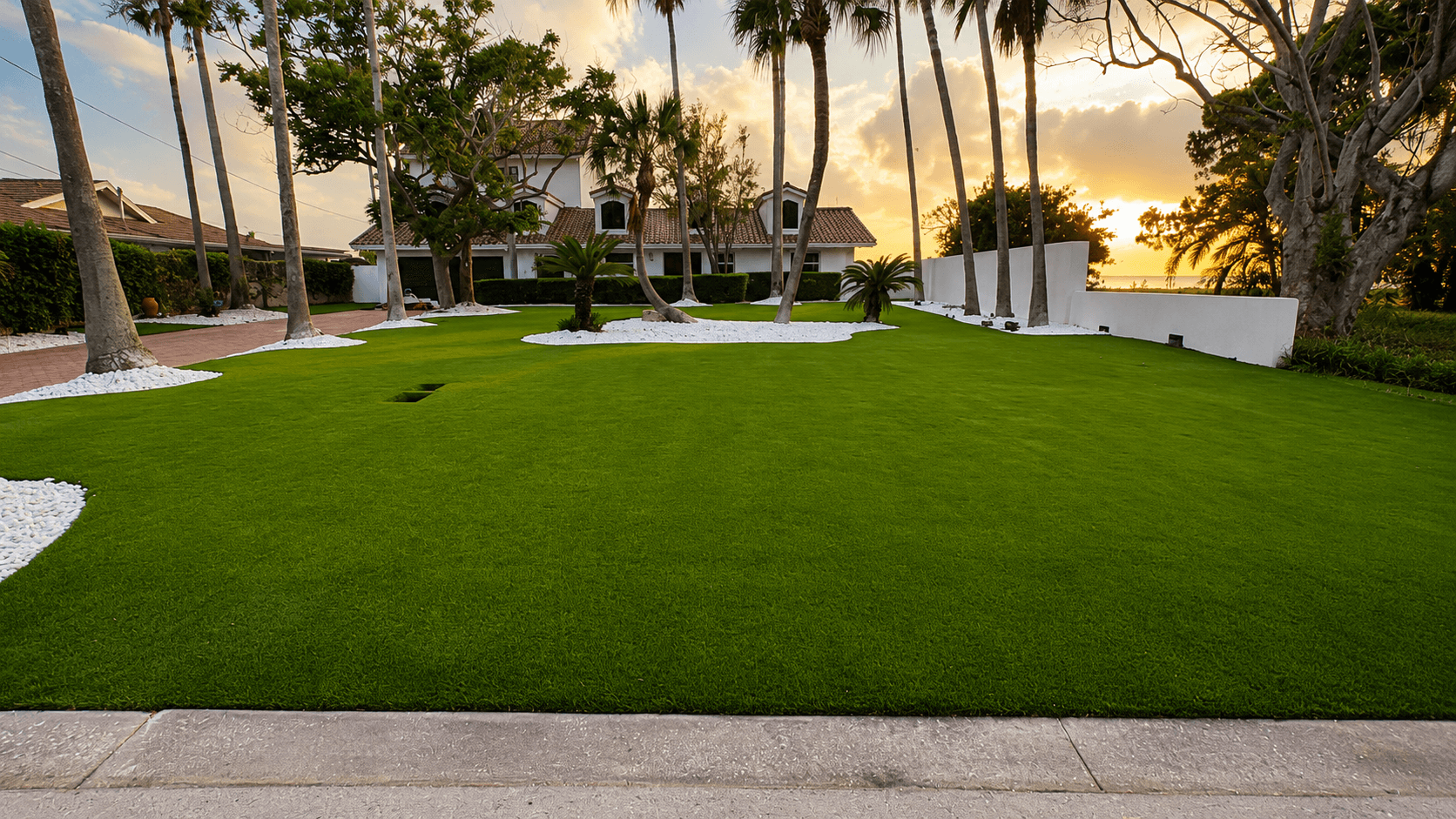
Florida homeowners fight three battles every year that most of the country never sees at the same intensity: mud after every afternoon thunderstorm, insects that treat a Tampa lawn like an all-you-can-eat buffet, and grass that needs constant mowing to keep up with heat and humidity. Artificial turf takes all three off the table at once. Rock N Block Turf N Hardscapes has been installing synthetic grass across the Tampa Bay area for years, from St. Petersburg to Wesley Chapel, and this post walks through exactly how the right turf system solves Florida’s toughest lawn problems.
Is Artificial Turf Easy to Maintain?
Artificial turf is dramatically easier to maintain than natural grass in Florida. No mowing, no watering, no fertilizing, no pest treatments, no reseeding, and no mud. A synthetic lawn takes roughly 30 minutes of light care per month compared to the hours per week a natural Florida lawn demands. The maintenance savings show up immediately in time, water bills, and lawn service costs, and they compound over the 15 to 25 year lifespan of a properly installed system.
Here is how artificial turf handles each of Florida’s three biggest lawn headaches.
Mud, Drainage, and Standing Water
Florida gets an average of 50-plus inches of rainfall per year, most of it in short, heavy afternoon downpours. Natural grass on Florida clay or sand simply cannot drain that much water fast enough, and the result is compacted, waterlogged spots that turn into mud pits after every storm. Those spots kill the grass, track into the house on shoes and paws, and stay soggy for days.
Artificial turf handles rain very differently. A professionally installed synthetic grass system uses:
- A leveled aggregate base of compacted crushed rock and sand, engineered to grade water away from the surface.
- Permeable turf backing with perforations that allow water to pass straight through.
- Advanced backing technologies such as Hydroflow and Optimum Flow that increase permeability.
Together, these components move water off the surface at rates that far exceed what compacted Florida soil can absorb, often draining over 30 inches per hour in independent tests. In practical terms, that means the yard is usable within minutes of a downpour, not days. No mud. No standing water. No footprints or tire ruts in soft ground.
Insects, Mosquitoes, and Other Pests
The second Florida lawn problem is bugs. Warmth, humidity, and standing water make Tampa and the Gulf Coast one of the most insect-heavy environments in the country. Mosquitoes, fire ants, chinch bugs, sod webworms, mole crickets, and armyworms all thrive on natural St. Augustine and Bahia lawns.
Artificial turf removes the conditions those insects need to survive:
- No food supply: Insects that eat grass, roots, or thatch simply cannot eat synthetic fibers. Chinch bugs, sod webworms, and mole crickets migrate elsewhere within weeks of a turf install.
- No standing water: Because artificial turf drains rapidly, mosquitoes lose the puddles they use for breeding.
- No soil habitat: A compacted aggregate base under artificial turf is inhospitable to ants, grubs, and other soil-dwelling insects that normally build colonies in Florida yards.
- No thatch buildup: Fleas, ticks, and other pests use thatch as shelter. Turf has no thatch.
- Optional gopher mesh: It can be installed beneath the turf during the initial base preparation for yards with historical rodent activity.
The practical result: dramatically fewer pesticide applications, no more constant lawn-treatment contracts, and outdoor spaces that are usable at dusk without being swarmed.
Lawn Maintenance Costs Cut to Near Zero
Beyond mud and bugs, the maintenance list on a Florida natural lawn is long. Every item on that list either goes away or shrinks significantly with artificial turf:
| Maintenance Task | Natural Grass in Florida | Artificial Turf |
| Watering | Two to three times per week in dry months | None required |
| Mowing | Weekly during growing season (March to November) | Never |
| Fertilizing | Two to four applications per year | Never |
| Pesticides and herbicides | Multiple applications per year | Rarely, if ever |
| Reseeding or resodding | Every few years for damaged areas | Never during normal 15-25 year lifespan |
| Aeration | Annually for clay soil | Never |
| Weeding | Ongoing | Occasional edge weeding only |
| Light monthly care | Not applicable | Rinse and brush against the grain (about 30 minutes) |
A typical Tampa Bay homeowner saves 30 to 40 hours of lawn work per year and significantly reduces water bills, fertilizer purchases, lawn service costs, and pest treatment contracts.
What Regular Turf Maintenance Actually Looks Like
Artificial turf still needs some upkeep, just far less than natural grass. A monthly routine typically includes:
- Rinsing the surface with a garden hose to remove dust and pollen.
- Brushing the blades against the grain with a stiff bristle broom to keep them standing upright.
- Removing leaves, seed pods, or other yard debris with a leaf blower or plastic rake.
- Topping off infill in high-traffic areas every few years.
- Inspecting seams and edges annually.
Do this and the turf keeps its color, shape, and drainage performance for its full lifespan.
Who Are the Best Companies for Artificial Turf Products & Installation?
Turf performance in Florida depends heavily on the product selection, the base preparation, and the drainage design. A great turf on a bad base fails within a year. A moderate turf on an expertly built base outperforms it for two decades. That is why installer choice matters more than most homeowners assume.
Rock N Block Turf N Hardscapes: Serving Tampa Bay and Beyond
Rock N Block Turf N Hardscapes has grown from a Las Vegas-based specialist into an eight-metro artificial turf and hardscape company, with an established Tampa Bay presence. In Florida specifically, Rock N Block serves Tampa, Saint Petersburg, Clearwater, Wesley Chapel, Safety Harbor, Riverview, and Pinellas Park. The company’s own summary of Florida conditions gets the challenge right: Tampa weather is tough on natural grass, heat, humidity, and heavy rain can turn lawns into a mess, and artificial turf keeps a yard green, clean, and ready to enjoy all year with zero mowing and zero mud.
Professional Installation Built on Base Preparation
The artificial grass installation process at Rock N Block starts long before the turf is unrolled. Site preparation includes:
- Removal of existing sod and vegetation.
- Grading for drainage.
- Compacted aggregate base construction using high-quality sand.
- Weed barrier where appropriate.
- Precise turf fitting, seaming, and edge securing.
This attention to the substructure is what makes the difference between a turf install that lasts 25 years and one that fails prematurely. In Florida’s rain and humidity, the base is arguably more important than the turf itself.
Four Product Lines Engineered for Different Needs
Rock N Block installs its own product lines, each engineered for a specific use case:
- Rockn80 with Hydroflow drainage technology, V and Z-shaped blades, white backing, and added folds. Built for durability against rain and pet urine.
- Natural-100 with Hydroflow drainage technology, delivering the most natural, authentic-looking finish in the lineup.
- Modern-103 with Optimum Flow technology and V and Z-shaped blades, designed for modern landscape aesthetics with resilient performance.
- Rockn Putt-85 with Optimum Flow technology, purpose-built for backyard putting greens.
All four products are installed under Rock N Block’s lifetime warranty on the artificial turf.
General Artificial Grass Services
Beyond specific product installations, Rock N Block’s artificial grass service covers residential and commercial applications, front and back yards, pet areas, playgrounds, patios, rooftops, and putting greens. That means one team can handle a complete outdoor transformation rather than juggling multiple contractors.
Full Service Area Coverage
Rock N Block operates in eight major metro markets: Las Vegas, Phoenix, Orange County, Santa Clara, San Diego, Denver, Tampa, and Utah. Each market has a direct local phone number, and the master line is (888) 894-2486. Tampa Bay clients can also reach the Florida team directly at 813-790-7105.
Accreditations and Partnerships
Rock N Block is a Better Business Bureau-accredited business and a HomeAdvisor-rated professional installer, and works with major landscape supply networks including SiteOne, Ewing Outdoor Supply, and Moon Valley Nurseries. In desert markets, the company also partners with the Southern Nevada Water Authority as part of the water-smart landscape rebate program.
Ready to Cut Mud, Bugs, and Maintenance from Your Florida Yard?
Florida homeowners do not have to choose between a natural lawn that is constantly waterlogged or brown and a bare yard with no green at all. Artificial turf gives you a lawn that survives every afternoon storm, keeps bugs out, and reduces monthly maintenance to a light rinse. Rock N Block Turf N Hardscapes installs synthetic grass systems designed for the specific challenges of the Tampa Bay climate, backed by a lifetime warranty on the turf and a full-service team that handles the entire project from base prep to final walk-through.
Book a free artificial turf consultation or call the Tampa team at 813-790-7105 (master line: 888-894-2486) to get a quote for your yard.
Frequently Asked Questions
1- How does artificial turf perform in Florida’s heavy summer rain?
A properly installed system drains far faster than Florida soil can absorb water. The aggregate base beneath the turf directs runoff away from the surface, and the perforated turf backing allows water to pass straight through, so the yard is usable within minutes of a downpour instead of days.
2- Will artificial turf really eliminate lawn insects in Florida?
It will not create a bug-free zone across your entire property, since insects still live in surrounding plants, mulch, and trees. What it will eliminate is the lawn habitat that draws chinch bugs, sod webworms, mole crickets, mosquitoes, fleas, ticks, and grubs. Yards with artificial turf typically see dramatic reductions in pest pressure and can often stop routine pesticide applications entirely.
3- How long does artificial turf last in Florida’s climate?
Quality artificial turf installed on a proper base lasts 15 to 25 years in Florida with normal residential use. UV stabilization in modern turf yarns protects against fading in intense Florida sun, and the drainage system prevents the waterlogging that shortens turf life in humid climates.
4- Does artificial turf get too hot to walk on in Tampa summers?
Turf can warm up in direct sunlight, especially in July and August. The practical mitigations are choosing a lower-density blade profile that allows more airflow, positioning turf in areas with partial shade, and rinsing the surface with a hose before use. In coastal Tampa Bay locations, sea breeze also helps keep turf cooler than in inland desert markets.
5- Is artificial turf safe for kids and pets in Florida?
Yes. Quality synthetic turf is made from lead-free, non-toxic polyethylene, the same plastic used in food containers and children’s toys. Rock N Block installs turf systems that meet current safety standards for residential use, and pet turf variants add antibacterial infill options for odor control.
6- What is the difference between residential artificial grass and pet turf?
Pet turf typically has shorter blades, more permeable backing, and antibacterial infill options for handling urine and waste. Residential landscape turf can be taller and denser for a fuller lawn look, which is fine for pure lawn areas but slower to clean in pet zones. Rock N Block matches the product to how the yard will actually be used.